Sunday, October 9, 2011

Nobel Prize 2011 Chemistry: Dan Schechtman

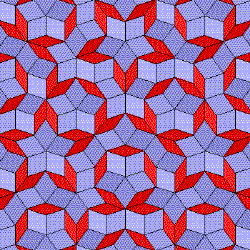
This is called a Penrose Tiling. This demonstrates the aperiodic layout of repeated tiling which gives an artistic visual of the quasicrystal.

I was first introduced to quasicrystals in physicist Lisa Randall's book, Warped Passages: Unraveling the Mysteries of the Universe's Hidden Dimensions. Randall was using them as an example of an every day item that may reflect "an ordered structure in a higher-dimensional world." She was talking about the Teflon on a pot or pan. Correction added 15OCT2011: Teflon is not what Ms Randall is describing... "non-stick" surface is more accurate...Teflon products have been around since long before the discovery of the non-stick effects of quasicrystal-reinforced surfaces. I apologize!


Dan Schechtman discovered the "impossible" crystalline structure over 20 years ago in a lab. In April of 1982, Schechtman had rapidly chilled a molten mix of aluminum and manganese expecting to observe complete disorder at the atomic level. Instead, he saw a crystal, except, it was one that did not make any sense.


It is important to note that the paradigm at the time was that crystals existed in limited numbers of rotation symmetry: 1, 2, 3, 4 & 6 fold. Not 5, and not greater then 6.

Quick vocabulary break down:
Crystals - usually, when atoms are arranged in a way which is periodic
Rotation Symmetry - When a shape or image can be rotated and it still looks the same. For 4-fold symmetry, for example, if you rotate the image four times, it looks the same each time (a square is of four fold symmetry).
Paradigm - a constant based not on theory but observation.

How the structure of an atom is observed: shine a monochromatic (or single wave-length of) xrays on a specimen. That beam is diffracted by the atoms and displays a pattern on the other side. This is where the symmetry number is revealed.


This is how an electron microscope works. What Schechtman saw was a diffraction pattern of electrons on a t.v. scanner...

What Schechtman did with his aluminum-manganese mix was observe the diffraction using an electron microscope and that diffraction pattern displayed a crystal with five-fold symmetry. It went against the paradigm which had existed since 1912! He quickly ruled out "twinned" atoms, or atoms which would have a mirror image in symmetry. What was significant about five-fold symmetry was that it produces a pattern that cannot be repeated; it takes the "periodic" out of the crystalline structure.


Schechtman was ridiculed by his peers for years, and he was even kicked out of his research group when he refused to back down on his findings.

Over the years, Schechtman's findings were slowly accepted into the scientific community and applied to modern technology, making stainless steel stronger (especially for small tools and instruments such as electric razors and surgical tools) and surfaces slicker. Quasicrystals have even been found to naturally occur in minerals found in a Russian river.


In her book, Lisa Randall explains the significance of quasicrystals to scientific theories that require extra spacial dimensions: "Quasicrystals are fascinating structures whose underlying order is revealed only with extra dimensions." As in, that periodical structure that can't be found in quasicrystals in three dimensions, may be, while not observable (by us), possible in extra dimensions of space. This would help to understand that non-stick pan coating: "The nonstick frying pans that are coated with quasicrystals exploit the structural differences between the projections of higher-dimensional crystals in the pan's coating and the more mundane structure of ordinary three-dimensional food."


Dan Schechtman's discovery resulted in some fantastic theory support as well as important applications. It is well deserving of a Nobel Prize. Congratulations, Prof. Schechtman!


References:

Randall, Lisa. Warped Passages Unraveling the Mysteries of the Universe's Hidden Dimensions. Harper Perennial. 2005.

"The Nobel Prize in Chemistry 2011 - Popular Information". Nobelprize.org. 10 Oct 2011 http://www.nobelprize.org/nobel_prizes/chemistry/laureates/2011/info.html

Technion Institue - Interview with Prof. Dan Shechtman.
http://www.youtube.com/watch?v=EZRTzOMHQ4s

Saturday, September 10, 2011

Just Some Optical Illusions

Well, due to the start of school (for my kid, not me...) this next week and travelling for work, I have been neglecting my poor science blog! :( Have no fear...though I don't have anything of depth prepared, I'd like to take this opportunity to display some things I have stumbled across while surfing the web and for this post, some illusions I had not up to this point encountered yet. I hope you enjoy and I promise to resume my regularly scheduled programming very soon!!

Are these really spiralling? :)

I like this next one, and nope, no animation! :)


And this video is a great compilation of some good illusions...accompanied by some fun music and a silly man, lol. ;)


Thank you all! If you have any good links to illusion pics or videos, please share in the comments!

Saturday, August 27, 2011

Oil Spill Series: Waves

Waves

“Although there are many processes and factors that may need to be taken into consideration to assess operational safety or the fate of spilled oil, the dominant process on shorelines is that of wave action (Owens, 1-8).”

There are two aspects of waves I want to expand on here: the origination of waves out at sea, and the behavior of the wave when it reaches the shore.

Origination of Waves
That’s easy enough: Wind. Any questions? Just kidding…Though not about the wind part. Lets travel out to the open ocean.

At first, the wind doesn’t have much to work with…the surface of a calm sea provides little roughage for the wind to push on and create movement. It is the tiny ripples that form as the wind moves over the surface that begin to travel (as oscillating waves) and GROW the more surface the crest gives for the wind to push on…make sense? Let me put it this way:

The second and third pictures here are showing the effect of “wind stress” which is what is happening as the wave allows more surface area for the wind to push…therefore, wind stress is a square function (oh, imagine that with the natural parabola formed in the wave trough! I love when math shows up in nature…) that is conversely dependant on the roughness of the sea, which depends on the wind stress. Clear as mud? Good. Lets move on.

Fetch: The distance which wind blows over water.
This is what is causing fully developed seas to become swell.


Now, in case it hasn’t been made obvious yet, the water is NOT traveling with the wave…the wave is an oscillation of energy traveling through the medium of liquid, in this case the ocean water. In fact, as you travel deeper under the surface of the water (in the deep ocean) that oscillation disappears slowly. This aspect is what changes as you near the shore…where the waves “break.”

Waves, Shallow Water and the Shoreline

As the swell travels toward the shore, it encounters shallow water. Now the energy of the wave actually causes the water in place to travel in a circular motion (this is why it does not travel fully forward with the wave). As the circular motion of the water encounters the sea-bed, it becomes elliptical. This happens when the depth of the water is half the wavelength (Bloomfield, 293).

Now we have a wave that is slowing down due to obstacle (seafloor) and bunching together. In addition to this, the height of the crest and depth of the trough (or its amplitude) increases to keep up momentum despite the slowing. Now, as all this is happening, the wave begins to refract, or bend the direction of travel, to approach the beach or shore more directly.

Now, as the crest of the wave carries forward the circular motion, the bottom encounters the shore or land and this causes the momentum to create the breaking of the wave.


Formulas:

Wind stress magnitude is calculated from wind magnitude as τ = ca ρa |u|2
where ρa = 1.2 kg m-3 is the density of air, ca = 0.0015 a dimensionless drag coefficient, u the wind speed and |u| its magnitude.

As Pertains to Oil Spills
There are a couple of things to remember about waves during an oil spill response. There exist what are called wave generated beach cycles.
“When waves reach the shoreline, they dissipate their energy:
  • Spilling or surging breakers tend to build up a beach (accretion), and
  • Plunging breakers move sediments seaward causing erosion (Owens, 1-12).”
This difference in dissipation of energy needs to be recognized so that the responder can know where to look for the oil on a particular beach.
If you are dealing with commonly spilling or surging breakers, you will be looking up the beach and digging, whereas, with plunging breakers, be aware of oil coming ashore more slowly over time.

Reference:
Bloomfield, Louis A. How Things Work. John Wiley & Sons, Inc. 2006.

Owens, Ed. Shoreline Operations and SCAT Surveys for Oil Spills on the West Coast. Polaris Applied Sciences, Inc. 2010

Friday, August 26, 2011

I Interrupt This Series to Bring You Breaking News: Quick Blurb on Hurricanes

How Hurricanes Form
What is needed:
·         Warm water (at least 80° F)
·         High humidity
·         Moist air
·         Warm surface temperatures
This is why hurricanes can be tracked for a while in advance; they typically form off the coast of Africa in the Atlantic ocean, by the equator, and travel over the open ocean. This gives the continuous evaporation and condensation cycle that is necessary to the tropical storm to get stronger. As the water condenses, it gives off latent heat and this decreases surface pressure.
Now the air begins to rotate around the low pressure area, continuing the evaporation and condensation cycle.

Irene in particular is encountering an area of dry air, which will help to weaken her. However, the risk of storm surges (which are usually what cause the most significant damage when a hurricane is due to make landfall) is still high and extremely likely.

Storm Surges
These are exactly what they sound like. Surges of the coastal waters being pushed by the wind and low pressure (this is responsible for about 5% of the surge). With Irene pushing on toward densely populated parts of the North Eastern United States, this is a huge issue regardless of her category being downgraded; between high sea-level populations and underground transit systems, the damage is estimated to be in the multibillion dollar range (Associated Press, 26AUG11).

Monday, August 22, 2011

Oil Spill Series: Tides

The physics of the ocean is essential to understanding the science of an oil spill. Besides the actual content of the oil and its effect on the environment, it is important to understand how the water behaves. This leads to processes which can determine the behavior or weathering of the oil. It plays a role in a responder’s ability to conduct clean-up.
When oil hits the water, earth’s forces immediately begin to go to work on it, both from above and below. For this segment, we look at how the tides work.


Tides
One of the cool things about the tides is that despite the constantly varying heights, they are completely predictable. We have predicted tides for a hundred years and more in the future (when I say “we” I don’t mean me…sounds like a completely tedious task, but I am glad someone out there enjoyed it enough to do it).

The tides are being influenced by three things: Gravity of the moon, the Earth’s rotation, and even a bit by the Sun’s gravitational pull. Each day, as the earth rotates, the gravitational pull of the moon creates a “bulge” on the earth and this causes a tidal change from low to high and high to low every 6 and a half hours.


Twice a month, the sun and moon are aligned (Full Moon and New Moon). When this occurs, the gravitational pull is even stronger and creates what are called Spring Tides. When the moon is at a right angle to the sun (half moon), the tidal change is less significant and is called a Neap Tide. The spring tide during the equinoxes have the highest tidal range (Owens, 1-17).

Equinox: the time when the sun crosses the plane of the earth's equator, making night and day of approximately equal length all over the earth and occurring about March 21 (vernal equinox or  spring equinox) and September 22 (autumnal equinox).


With these parameters laid out for us, the rule of thumb is that the tides at the equator (where the bulge is) are typically larger than those to the north or south. That is, until you take into account the geography.
Where your normal equatorial tide change is typically right around 2 meters, an example of a large tidal change due to tidal resonances is the Bay of Fundy (located between New Brunswick and Nova Scotia). The geography of this estuary supports a 15 meter tidal change (Bloomfield, 288)!

Resonance: is the tendency of a system to oscillate at a greater amplitude at some frequencies than at others

Resonance is a fascinating topic for another post, but note: due to the design of the landscape which the wave is traveling through, this tidal resonance occurs and causes phenomena such as the Bay of Fundy, the Cook Inlet in Alaska, and a handful of others.

Now, keeping in mind that this massive tidal change must still take place within the span of 6.5 hours, you can imagine the speed at which the ocean must move. Don’t get caught out there! This is a good concern to keep in mind when an oil spill response occurs in these areas…


The tank vessel EXXON VALDEZ struck Bligh Reef on March 24th, 1989. What is the significance of this date? Remember the effect that the equinox has on tides and when the equinox occurs? Also, what is the average tidal change for an area like Prince William Sound? These tidal effects all played a part in the behavior of the spill and the direction of the response to it.


Reference:
Bloomfield, Louis A. How Things Work. John Wiley & Sons, Inc. 2006.

Owens, Ed. Shoreline Operations and SCAT Surveys for Oil Spills on the West Coast. Polaris Applied Sciences, Inc. 2010

Sunday, August 21, 2011

Series: Oil Spills

For the next few posts, I will be talking about subjects that I have become familiar with in my job: Oil Spills. Where they go, what happens to the ecosystem, the science behind response and response equipment, etcetera.
Keep in mind throughout the series that all the elements of oil spills are complex and variable; like fingerprints, no two oil spills are alike, even if they are in the exact same location. As I write and publish each of these posts, I will update this post with links to the posts that are part of the series. As an introduction, here are some pictures:
"This is a radar image of an offshore drilling field about 150 km (93 miles) west of Bombay, India, in the Arabian Sea. The dark streaks are extensive oil slicks surrounding many of the drilling platforms, which appear as bright white spots."

The EXXON VALDEZ and the oil spill caused by the vessel's collision with Bligh Reef in1989.

Clean-up during the Exxon Valdez spill...this technique was not always better then leaving the oil in place, which I will address when I post about mechanical clean-up techniques.


This is a sattelite image of the Deepwater Horizon oil spill in the Gulf of Mexico, taken days after the intial oil-rig explosion in April, 2010. This turned into the worst environmental disaster in U.S. history. Photo from The Global Herald

Disclaimer: Any views and/or opinions expressed in The Masqerading Scientist are solely those of the author and not of the U.S. Coast Guard or any other U.S. federal agency. Thank you!

Sunday, August 7, 2011

Plan to Save the Whales

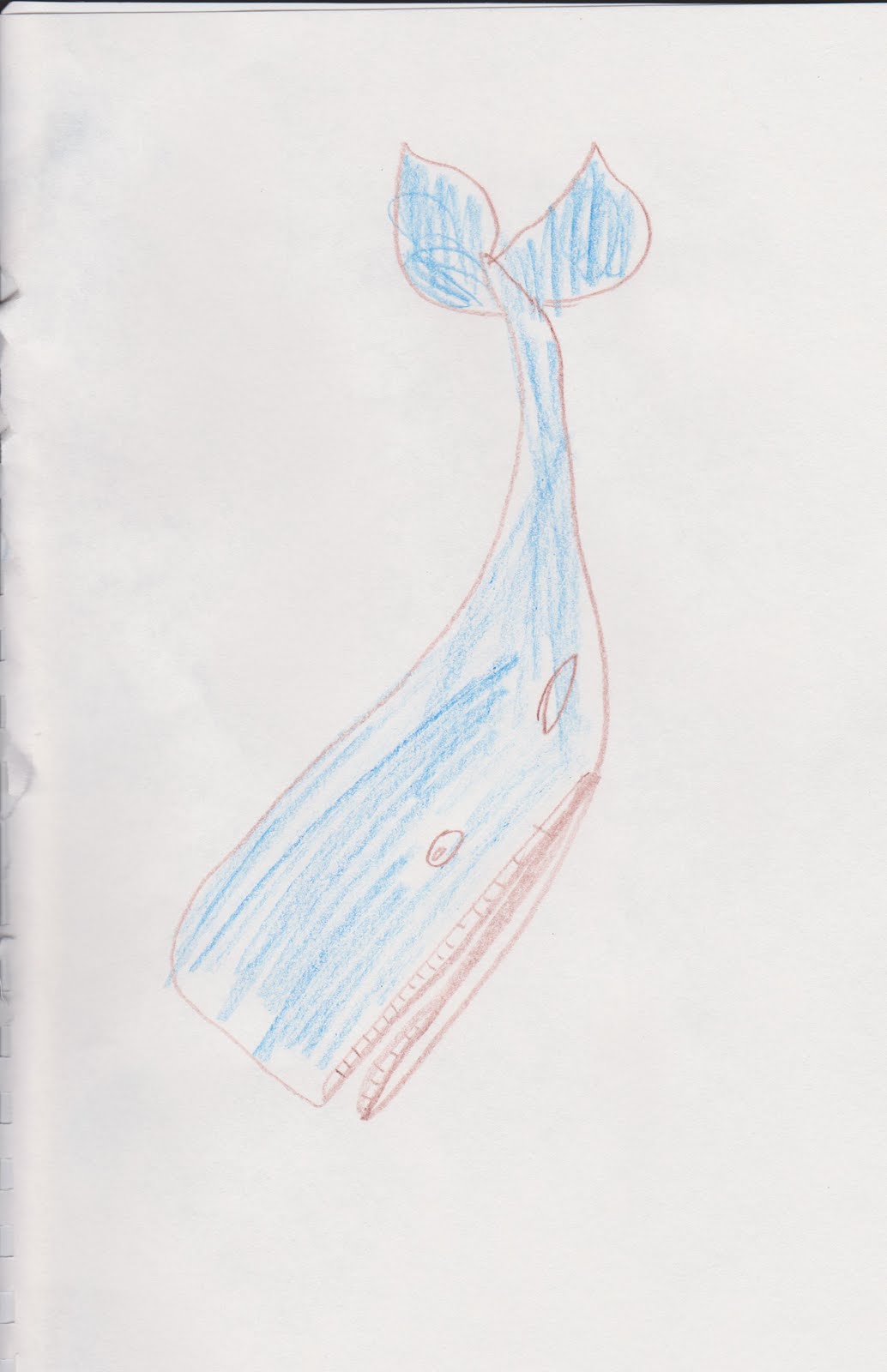
This is a guest blog post written and illustrated by my daughter, Lily. She is 9 years old and has a passion for these wonderful creatures. These views are not all necessarily the views of anyone BUT a wonderful and curious little girl, so please, Enjoy!


Plan to Save the Whales


You know, lots of people love whales and they love to see whales; but the whales are endangered. To keep up the fun of whale watching, we need to do something before they are extinct.
Easy Home ways to save the whales:
  • Cool down the earth by biking or walking to places that aren't far away
  • Turn off electronics when not in use
  • When you go to the bathroom, don't use a lot of toilet paper, because everything that goes down the toilet or drain ends up in the ocean
  • Take short showers and don't make them that hot.

Whales sometimes get beached. So here is how you can save them if they do. If the whale is light enough, put wet blankets over it and wait for a helicopter to pick up the whale and move it back to the ocean. If the wale is like a Sperm Whale or a Blue Whale, put wet blankets on it and wait for the tide to come in and quickly pull off the blankets.


So keep your ocean clean and don't allow whaling!

References:
Mom & Dad propaganda


Briarcrest Elementary 3rd Grade Class