Showing posts with label Physics. Show all posts

Saturday, December 31, 2011

Subatomic Particles and The Standard Model

As the name might suggest, subatomic particles are particles that are smaller than an atom... Which is an interesting conundrum for the atom: The Greek root for the word atom, "atomon," means "that which cannot be divided." 
When atoms were first decidedly discovered, they were thought to be fundamental, a not-dividable particle that made up all elements. But as compounds and solutions were broken down into elements, and these elements became more categorical, it seemed that even individual atoms had to possess smaller building blocks.


"...experiments which "looked" into an atom using particle probes indicated that atoms had structure and were not just squishy balls. These experiments helped scientists determine that atoms have a tiny but dense, positive nucleus and a cloud of negative electrons (e-)."(Berkeley Lab, 2011)


Picture credit: wikispace History of the Atom


Soon enough, scientists had determined that an atom is made up of three sub-atomic particles: Protons and Neutrons in the nucleus and that cloud made up of the much smaller elementary particle, the electrons. But are these three particles fundamental? Well, the electrons are. 


So electrons are (to date considered) fundamental subatomic particles. But what, then, are protons and neutrons made of? 
Protons, it turns out, are made of two "up" quarks and one "down" quark, held together with a "cloud of gluons" (R. Nave).
Neutrons are made up of two "down" quarks and one "up" quark. 


What scientists have developed to determine fundamental particles is the Standard Model Theory. This theory has been supported through experimentation in particle accelerators such as the Large Hadron Collider(LHC) at CERN. 
The Standard Model has 12 fundamental matter particles: six quarks and six leptons. The up and down quarks are just two of the quarks; there are also: charm, strange, top and bottom quarks.
Leptons include the electron as well as the following: neutrino electron, muon, tau, muon-neutrino and tau-neutrino.

picture credit: Cern, http://public.web.cern.ch/public/en/science/standardmodel-en.html

These particles are members of multiple generations, 1st, 2nd and 3rd. Up and down quarks, for example, make up the first generation of quarks. The second and third generation particles are heavy and unstable and quickly decay to the more stable first generation. This is why our protons and neutrons are made of first generation quarks, and why it is electrons that occupy the cloud surrounding the atom's nucleus.


The Standard Model Theory does include forces and carrier particles which play a role in keeping atoms together. Carrier particles are carrying three of the four forces known: strong and weak nuclear forces and electromagnetism. Note that gravity is not included which is part of the reason that this model is not considered complete enough for the science community. These forces hold together the matter particles and the carrier particles include bosons, photons and gluons. Photons carry electromagnetism, bosons carry the weak force and gluons carry the strong force. Now if gravity could be added to the Standard Model, a carrier particle called a graviton could be included, but so far, scientists have not been able to produce any results to add the force and its carrier. This is one of many goals of the LHC and it's collaborators. 


References:
Berkeley Labs. http://particleadventure.org/standard-model.html. accessed 29Dec2011

Nave, C. R. and Sheridan, John, The Microwave and Infrared Spectra and Structure of Hydrothiophosphoryl Difluoride, Journal of Molecular Structure 15, 391, 1973. (http://hyperphysics.phy-astr.gsu.edu/hbase/particles/proton.html).

CERN, European Organization for Nuclear Research http://public.web.cern.ch/public/en/science/standardmodel-en.html . 2008.

Friday, November 11, 2011

Galaxies!

This is another guest post from my nine-year-old daughter, Lilian. Lilian loves astronomy and was excited to do this one! -Dorian

By Lilian Satterlee

When you look up at the night sky, you might only see tens of stars in the area of your galaxy. But all you see is not all there is! Our galaxy has not only 50 stars, but billions. We live in a galaxy called the Milky Way, a spiral galaxy with hundreds of thousands of billions of stars.

Our Milky Way Galaxy

IC 1011, largest known galaxy
 As big as it is, it is only a speck compared to this giant: IC 10-11 is the largest galaxy ever found. It is 60 times larger than our Milky Way.
M 87 is one of the oldest galaxies in the known universe.

M87
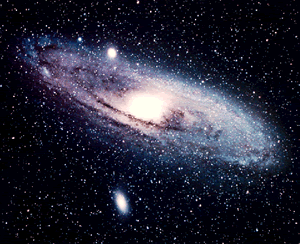
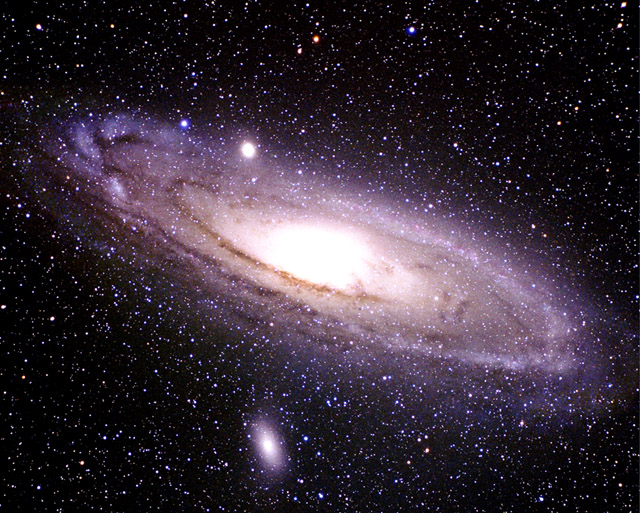
Our neighbor, Andromeda
Andromeda is our nearest neighbor. All galaxies are different, unique, big and everywhere.


How Galaxies Formed!
It takes gravity to make stars and pull them together. Early galaxies were a big mess; lumpy clumps of stars, dust and gas. Today, galaxies are neat and organized, and gravity is what makes that happen.


So remember, galaxies are made of billions of stars and there are billions of galaxies!

Sunday, October 9, 2011

Nobel Prize 2011 Chemistry: Dan Schechtman

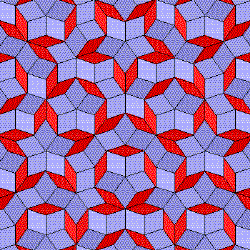
This is called a Penrose Tiling. This demonstrates the aperiodic layout of repeated tiling which gives an artistic visual of the quasicrystal.

I was first introduced to quasicrystals in physicist Lisa Randall's book, Warped Passages: Unraveling the Mysteries of the Universe's Hidden Dimensions. Randall was using them as an example of an every day item that may reflect "an ordered structure in a higher-dimensional world." She was talking about the Teflon on a pot or pan. Correction added 15OCT2011: Teflon is not what Ms Randall is describing... "non-stick" surface is more accurate...Teflon products have been around since long before the discovery of the non-stick effects of quasicrystal-reinforced surfaces. I apologize!


Dan Schechtman discovered the "impossible" crystalline structure over 20 years ago in a lab. In April of 1982, Schechtman had rapidly chilled a molten mix of aluminum and manganese expecting to observe complete disorder at the atomic level. Instead, he saw a crystal, except, it was one that did not make any sense.


It is important to note that the paradigm at the time was that crystals existed in limited numbers of rotation symmetry: 1, 2, 3, 4 & 6 fold. Not 5, and not greater then 6.

Quick vocabulary break down:
Crystals - usually, when atoms are arranged in a way which is periodic
Rotation Symmetry - When a shape or image can be rotated and it still looks the same. For 4-fold symmetry, for example, if you rotate the image four times, it looks the same each time (a square is of four fold symmetry).
Paradigm - a constant based not on theory but observation.

How the structure of an atom is observed: shine a monochromatic (or single wave-length of) xrays on a specimen. That beam is diffracted by the atoms and displays a pattern on the other side. This is where the symmetry number is revealed.


This is how an electron microscope works. What Schechtman saw was a diffraction pattern of electrons on a t.v. scanner...

What Schechtman did with his aluminum-manganese mix was observe the diffraction using an electron microscope and that diffraction pattern displayed a crystal with five-fold symmetry. It went against the paradigm which had existed since 1912! He quickly ruled out "twinned" atoms, or atoms which would have a mirror image in symmetry. What was significant about five-fold symmetry was that it produces a pattern that cannot be repeated; it takes the "periodic" out of the crystalline structure.


Schechtman was ridiculed by his peers for years, and he was even kicked out of his research group when he refused to back down on his findings.

Over the years, Schechtman's findings were slowly accepted into the scientific community and applied to modern technology, making stainless steel stronger (especially for small tools and instruments such as electric razors and surgical tools) and surfaces slicker. Quasicrystals have even been found to naturally occur in minerals found in a Russian river.


In her book, Lisa Randall explains the significance of quasicrystals to scientific theories that require extra spacial dimensions: "Quasicrystals are fascinating structures whose underlying order is revealed only with extra dimensions." As in, that periodical structure that can't be found in quasicrystals in three dimensions, may be, while not observable (by us), possible in extra dimensions of space. This would help to understand that non-stick pan coating: "The nonstick frying pans that are coated with quasicrystals exploit the structural differences between the projections of higher-dimensional crystals in the pan's coating and the more mundane structure of ordinary three-dimensional food."


Dan Schechtman's discovery resulted in some fantastic theory support as well as important applications. It is well deserving of a Nobel Prize. Congratulations, Prof. Schechtman!


References:

Randall, Lisa. Warped Passages Unraveling the Mysteries of the Universe's Hidden Dimensions. Harper Perennial. 2005.

"The Nobel Prize in Chemistry 2011 - Popular Information". Nobelprize.org. 10 Oct 2011 http://www.nobelprize.org/nobel_prizes/chemistry/laureates/2011/info.html

Technion Institue - Interview with Prof. Dan Shechtman.
http://www.youtube.com/watch?v=EZRTzOMHQ4s

Saturday, July 30, 2011

Microwave Ovens

Have you ever wondered how your microwave warms up your food, or worried that this mysterious process might be mutating what you ingest or even that those microwaves are escaping the box and penetrating your insides? Well, hopefully I can shed at least a little light on this magic hotbox and allay, well, some of your fears anyway.
Speaking of light, let me start with explaining what a microwave is. As in the actual, electromagnetic wave. You may have heard that light travels in waves, and that each color has a different wavelength. The rainbow shows the spectrum, and these colors are always in the same order...based on their wavelengths and frequencies. These visible waves are only a fraction of the spectrum. Other electromagnetic waves include radio waves, infra-red, x-rays, etc. (see spectrum below definitions).
Wavelength: Physics . the distance, measured in the direction of propagation of a wave, between two successive points in the wave that are characterized by the same phase of oscillation. Or:
Frequency: the number of cycles or completed alternations per unit time of a wave or oscillation. Symbol:  F; Abbreviation:  freq. Or:
1 Hz means that an event repeats once per second.
To demonstrate where your everyday waves fall on a spectrum, including the microwaves we are preparing to discuss, here is a helpful little picture:

Fantastic. Now we realize that the force we are working with in a Microwave Oven is electromagnetic, and have a basic understanding of the spectrum.
      The most important part of your microwave oven is the Magnetron. This nifty device is what is actually creating the microwaves and sending them into the box. When power is supplied electronically (i.e., plug it in and turn it on), the magnetron produces simultaneous electric and magnetic fields that oscillate at the right frequency to create microwaves. These microwaves emit from the magnetron, and are reflected off metal surfaces: A metal fan sends waves into the oven segment, the metal lined walls of the microwave oven reflect the waves throughout and back and forth.
      So now you have microwaves being reflected around the oven. What happens when you add food? First, let’s look at the make-up of the food you eat. Do you know what is common in almost everything you ingest? It’s water molecules. It is these molecules of H2O that are the key to microwaves increasing the temperature of the object inside the oven. This is due to the fact that these molecules are polarized.
      When the Oxygen (O) atom combines with the two Hydrogen (H2) atoms, it pulls the electrons partly from the Hydrogen…creating a negative charge on the Oxygen end of the molecule. This in turn creates a positive charge on the H2 end of the molecule, and there you have your polarization.
      As the fluctuating electric field of a microwave passes by these water molecules, it causes the polarized water to in turn fluctuate…and at the speeds that they begin to fluctuate, heat is in turn created! The excited water is turning the work energy into heat and that is a thermodynamics lesson for another post.
This leaves us with a couple of questions still from the introduction.
Are these microwaves escaping and cooking your insides? The answer is no. Take a look at your microwave oven. All the walls, save the door, are all-metal surfaces. The door is a mesh design of metal and amazingly, those holes in the mesh are TOO SMALL to allow the escape of the microwaves. Fabulous, right?
Are these microwaves mutating your food? Pure water molecules are not going to be changed by the effects of microwaves. That being said, the complex carbon chains that make up the rest of most foods may be affected by the microwaves, but to what extent, I don’t know. If you know, please feel free to post a response, I would love to hear what others have to say!
Experiment:
Try (with adult supervision, if you are a minor) microwaving an ice-cube or ice-cubes. What happens? Can you explain why?
Formula (for the math-happy science geeks):
C = λ(ν) or speed of light = wavelength times frequency
Electromagnetic waves always travel at the speed of light, and therefore, the higher the frequency, the shorter the wavelength.


References:

Bloomfield, Louis A. How Things Work. John Wiley & Sons, Inc. 2006. p 432.

 Fischetti, Mark. How the Microwave Works. Scientific American. Oct 30, 2008.
http://www.scientificamerican.com/article.cfm?id=how-the-microwave-works
viewed at link on Jul 30 2011.

Definitions from: http://www.dictionary.com/