Showing posts with label Physical sciences. Show all posts

Sunday, April 1, 2012

Nanotechnology and Food

             The word technology often makes the public nervous when it is coupled with the word food. It is understandable that when it comes to what is ingested and used to sustain the human body, the consensus is that Mother Nature knows best. It might seem, then, that the idea of nanotechnology being incorporated with food would not be welcomed with open arms. Yet, if a dairy farmer were to gaze at his product at the nano-level, it might intrigue him to see the natural occurrence of nanoparticles in the casein micelles that inspire such technology (Institute of Medicine).

            Nanotechnology is definitively broad; it is conducting science, engineering and technology at the nanolevel of 1 to 100 nanometers, according to the National Nanotechnology Initiative (NNI) at the Nano.gov website. This scale is not new to the processes of human digestion, as indicated in the introduction; most of the processes in the body take place at the nano-level (Institute of Medicine). What makes this technology different and unique is that at the nanometer range, materials have new and unique properties and novel functions (Poole and Owens 4). Due to its interdisciplinary possibilities, the funding and investment for research is quite high and can prove to provide innovation to food processing and products (Neethirajan 39). The benefits of using nanotechnology in food production would include nutrition enhancement and safety regulation enhancement, yet there exists a gap of knowledge of risks which need to be evaluated by national, global and private organizations.
Image credit: http://www.sustainpack.com/nanotechnology.html
            Nanotechnology currently offers many benefits outside the food industry. Manufactured nanotechnology has actually existed for thousands of years; evidenced in iridescent goblets from the fourth century A.D. and stained glass used for centuries following (Poole and Owens 1). Today it is found in everyday sports items like tennis rackets and baseball bats; in rechargeable batteries for automobiles; and in household cleaning products (Nano.gov). Besides the advantage of funding that such an interdisciplinary science has, the applications can also offer crossover applications.

Raj Patel, in the Introduction of his book Stuffed and Starved: The Hidden Battle for the World Food System, presents a problem in today’s society: while 800 million global citizens go hungry, one billion are at the same time overweight. Both groups are malnourished. Accompanying this problem of inadequate food is the issue of sustainable food. Currently, production has kept up with exponential human growth and the hunger of 800 million is likely due to a corrupt food market system and various global conflicts and not overpopulation (Patel). Yet the evidence of the inability to sustain our current production starts with the beginning of agriculture. While human population has spent most of its existence on earth in a steady state with little growth, the introduction of agriculture spurred the exponential population growth (Sagan 16). As human quality of life now depends on the continuation of agriculture, it is important to ensure its sustainability not only for population but also for the changing climate.
Wireless nanosensor networks. Image credit:
http://www.nano.org.uk/forum/viewtopic.php?p=8875


One field of nanotechnology application is in food quality monitoring. Nanosensors offer the ability to track contaminants from the farm to the table. Beginning in the fields, nanosensors, through remote sensing devices that may be applied to crops, can monitor pest infestation, soil conditions and growth, helping to minimize pesticide use and utilize the full potential of cropland (Meetoo 392). Currently being proposed for monitoring grain bins are nanosensors that can detect insects or fungus through thousands of nanoparticles distributed on single, lightweight sensors. Other sensors are being designed to detect E. coli and salmonella. These bacteria sensors, useful in the bulk and limited quantity transportation of foods, include Nano Bioluminescent spray being developed by Agromicron Ltd. The spray contains nanoparticles that react with bacteria and produce a visual glow to indicate infestation (Neethirajan 40). The application of sensors in the food system would be beneficial in assuring food safety and spoilage prevention. 
Another area of application in development is that of food packaging. This sector of the food industry seems to be advancing quickly, likely due to its indirect contact with food. It includes the use of nanosensors, but also takes advantage of the lightweight characteristic of nanotechnology. Silicon-based nanoparticles offer a lightweight, more heat-resistant and stronger covering for foods that require vacuum covering to stay fresh (Meetoo 394). Metal nanoparticles can be used for antimicrobial packaging, preventing bacterial and fungal growth on food and resisting dirt. Even edible food nanoparticles are being researched for such applications (Neethirajan 41).
Some of the most advantageous yet intimidating applications are those of nanotechnology being used for encapsulation. This is the use of nanoparticles containing nutrients, flavor enhancers or texture enhancers and utilizing a controlled release. This technology has been incorporated by an Australian company, George Weston Foods. Using encapsulation, the company fortifies its bread with fish oil and masks the taste and smell by keeping the oil encapsulated until digestion (Neethirjan 43). This is just one example of using the technology in this way.
Image Credit:
http://www.foodsci.uoguelph.ca/deicon/casein.html
The aforementioned milk protein, casein micelles, offers a natural model for encapsulation delivery. Water molecules are polar molecules; they have a positive end and a negative end. Micelles are made up of surfactants that have hydrophilic (water-favoring) heads that are also polar, and hydrophobic (water resistant) non-polar tails (Poole and Owens 326). These surfactants get together and form a nanoparticle (micelle) in nature that offers a biological delivery system. Scientists can take this design and synthesize a vitamin delivery system using these proteins (Neethrijan 43). Though encapsulation appears to present the most risk due to its direct interaction with food products, it also offers the most promise due to the natural blueprints available.
This particular delivery system can be incorporated with the sensor system to cater to individual needs and tastes. Sensors in nanocapsules can trigger a release of nutrients if it senses a lack of nutrients in the consumer. Microwaves can trigger sensors to release specific flavor or color enhancers. This delivery system can also be utilized for textures, adding the desired fatty texture to low-fat foods (Neethrijan 44).
Technology of any kind used in food processing and production is often viewed skeptically by the general public. This applies to not only western consumers, but also by what Raj Patel refers to in his book as the “global south,” the developing countries that while some of the biggest producers of agriculture are also the hungriest. Patel, in the For Africa! section of chapter 6 of his book, points out that countries such as Zambia have rejected food aid from the U.S. due to the incorporation of notorious genetically modified organisms (GMO’s) that the U.S. Food and Drug Administration (FDA) allows and that Zambia’s own scientists have been unable to vet for themselves. This aversion is completely understandable, and should be addressed by creating a global cooperation when it comes to incorporating nanotechnology into food; research should not rest solely in the hands of the profit-seeking corporations that seek to use it in their food products.
These concerns are not lost on regulators and scientists in the U.S. or even on global organizations. In 2010, the United Nations Food and Agriculture Organization (FAO) and the World Health Organization (WHO) had a meeting on the potential applications and safety concerns of nanotechnology in the food and agriculture sectors. In 2009, the National Science Foundation’s Institute of Medicine hosted a workshop forum on the same, with members of the FDA, Environmental Protection Agency (EPA) and National Science Foundation in attendance as contributors to discussion.
Image credit: 2007 How Stuff Works

One of the knowledge gaps in such a young technology that has only recently come to be considered for application in the food industry is that of how nanoparticles are distributed once ingested (World Health Organization 29). Most of the toxicology research done thus far has been in the occupational sector of nanotechnology, where workers are exposed to nanoparticles for short periods of time and the path of intake is more likely inhalation or absorption (through the skin) then ingestion/oral intake, which was pointed out in both of the meetings. In summary, the World Health Organization’s assessment of risks read as following:
“Future needs and ways forward to prevent human health risks at international and national levels concern knowledge (scientific and market data), resources (funding for studies, facilities and trained investigators), and processes (international scientific collaboration on characterization, methods design and testing; international, multistakeholder collaboration on guidelines development and harmonization; public engagement and societal governance).”
The knowledge, resource and process needs were laid out in the meeting report, with emphasis on the necessity for collaboration and public engagement.
            At the 2009 Institute of Medicine workshop, many safety concerns were brought up. The fact that nanomaterials fall within the biological size scale makes it possible that there can and will be interactions at the biological level; cellular interference and possible DNA interference. The Institute of Medicine published the discussions on these risks in the last chapters of its book, Nanotechnology in Food Products. In chapter three of this book, it was noted by speaker Fred Degnan, an attorney, that even with the FDA encouraging early and often dialogue with industry producing Nanotechnology, the FDA should work to provide written guidance for what it requires in research and development to approve nanomaterials in food products.  This would be a vast improvement to the FDA’s requirements for GMOs, as Patel points out in chapter six of Stuffed and Starved; Patel describes the the US Food and Drug Administration’s handling of new GM crops; that the research into the safety of these foods was left entirely in the hands of the profit-seeking private sector that was engineering the crops for consumption. Where the FDA could have done much more in the way of research, it relied on the words of an industry that had already invested significant amounts of time and money into crops that were supposed to make food more nutritious for world population. The FDA speaker at the workshop does acknowledge that the burden of proof of safety lies in the hands of the manufacturers (Institute of Medicine).
            Though the FDA has not yet publicly produced a set of written guidelines, the European Food Safety Authority (EFSA) has, which is a start to a more conformed regulatory process for global major food manufacturers. In the abstract of the paper, the European Food Safety Authority claims that it “has developed a practical approach for assessing potential risks arising from applications of nanoscience and nanotechnologies in the food and feed chain.” The EFSA overview lays out a flow chart, beginning with the question of whether or not the material in question is even an engineered nano-material (or ENM) and how to proceed from there on assessing the risk (9). That this guidance exists should be taken into consideration and used as a model for other regulatory and health agencies and organizations on the national and global levels. This consistency would aid in the collaboration of top tier scientists, academics and manufacturers as well as give the process transparency for the public.
            Consumer education is the most important aspect of integrating nanotechnology into food production. In an informal survey of less then one hundred people, two things stand out about public awareness on the subject: That the public understands little about the actual technology, and that they don’t want manufacturers to be the ones researching its use in their food (Satterlee). A more formal survey of a similar nature was conducted by the National Science Foundation and found that not only did half of the participants know “little or nothing” about the technology, only six percent cared to apply it to use in food (National Institute of Medicine). Julia Moore, of the Woodrow Wilson International Center for Scholars, spoke at the workshop for Nanotechnology in Food Products and had this to say after analyzing the surveys taken on the subject: “public opinion is really up for grabs when it comes to nanotechnology. The public really doesn’t know very much to have an opinion.” This emphasizes that scientists and organizations still have the opportunity to form public opinion about it, and transparency is going to count for a lot.
            One lesson learned from the failure of public information on GMOs might be best summed up in Patel’s book in chapter 6’s I’d Like to Thank the Academy. Patel describes a story of a whistle-blowing scientist, Ignacio Chapela. Chapela submitted and had published in the peer-reviewed journal Nature an article on the cross contamination of genetically modified maize in Mexico. The article was mysteriously retracted. In an attempt to avoid this type of corruption in the research of other technology in the food industry, it is promising that such a wide collaboration is involved. From academics to global organizations, the importance of transparency cannot be stressed enough to ensure that the benefits of nanotechnology are safely integrated into the food system. As consistency and guidance is produced, all involved in regulation and research will be aware that it is their responsibility to ensure safe and effective applications of technology.


Works Cited
European Food Safety Authority. “Guidance on the risk assessment of the application of nanoscience and nanotechnologies in the food and feed chain.” EFSA Journal 9.5 (2011) : 1-36. Web. 24 Feb 2012.
Institute of Medicine of the National Academies. Nanotechnology in Food Products Workshop Summary. Washington, D.C.: National Academies Press, 2009. Electronic book.
Meetoo, Danny D. “Nanotechnology and the food sector: From the farm to the table.” Emirates Journal of Food and Agriculture. 23.5 (2011): 387-403. Web.
Nano.gov. National Nanotechnology Initiative. Web. 22 Feb 2012
Neethirajan, Suresh. “Nanotechnology for the Food and Bioprocessing Industries.” Food and Bioprocess Technology. 4.1 (2010): 39-47. Web.
Patel, Raj. Stuffed and Starved: The Hidden Battle For the World Food System. Brooklyn, N.Y.: Melville House Publishing, 2007. Electronic book.
Poole, Charles P. and Frank J. Owens. Introduction to Nanotechnology. New Jersey: John Wiley & Sons, Inc, 2003. Print.
Sagan, Carl. Billions & Billions. New York: Randomhouse, 1997. Print.
Satterlee, Dorian. “Survey on Nanotechnology and Food.” Survey monkey, Feb. 2012. Web.
World Health Organization. “FAO/WHO Expert meeting on the application of nanotechnologies in the food and agriculture sectors: potential food safety implications Meeting report.” Rome : FAO and WHO, 2010. 1-130. Web.

Saturday, December 31, 2011

Subatomic Particles and The Standard Model

As the name might suggest, subatomic particles are particles that are smaller than an atom... Which is an interesting conundrum for the atom: The Greek root for the word atom, "atomon," means "that which cannot be divided." 
When atoms were first decidedly discovered, they were thought to be fundamental, a not-dividable particle that made up all elements. But as compounds and solutions were broken down into elements, and these elements became more categorical, it seemed that even individual atoms had to possess smaller building blocks.


"...experiments which "looked" into an atom using particle probes indicated that atoms had structure and were not just squishy balls. These experiments helped scientists determine that atoms have a tiny but dense, positive nucleus and a cloud of negative electrons (e-)."(Berkeley Lab, 2011)


Picture credit: wikispace History of the Atom


Soon enough, scientists had determined that an atom is made up of three sub-atomic particles: Protons and Neutrons in the nucleus and that cloud made up of the much smaller elementary particle, the electrons. But are these three particles fundamental? Well, the electrons are. 


So electrons are (to date considered) fundamental subatomic particles. But what, then, are protons and neutrons made of? 
Protons, it turns out, are made of two "up" quarks and one "down" quark, held together with a "cloud of gluons" (R. Nave).
Neutrons are made up of two "down" quarks and one "up" quark. 


What scientists have developed to determine fundamental particles is the Standard Model Theory. This theory has been supported through experimentation in particle accelerators such as the Large Hadron Collider(LHC) at CERN. 
The Standard Model has 12 fundamental matter particles: six quarks and six leptons. The up and down quarks are just two of the quarks; there are also: charm, strange, top and bottom quarks.
Leptons include the electron as well as the following: neutrino electron, muon, tau, muon-neutrino and tau-neutrino.
picture credit: Cern, http://public.web.cern.ch/public/en/science/standardmodel-en.html

These particles are members of multiple generations, 1st, 2nd and 3rd. Up and down quarks, for example, make up the first generation of quarks. The second and third generation particles are heavy and unstable and quickly decay to the more stable first generation. This is why our protons and neutrons are made of first generation quarks, and why it is electrons that occupy the cloud surrounding the atom's nucleus.


The Standard Model Theory does include forces and carrier particles which play a role in keeping atoms together. Carrier particles are carrying three of the four forces known: strong and weak nuclear forces and electromagnetism. Note that gravity is not included which is part of the reason that this model is not considered complete enough for the science community. These forces hold together the matter particles and the carrier particles include bosons, photons and gluons. Photons carry electromagnetism, bosons carry the weak force and gluons carry the strong force. Now if gravity could be added to the Standard Model, a carrier particle called a graviton could be included, but so far, scientists have not been able to produce any results to add the force and its carrier. This is one of many goals of the LHC and it's collaborators. 


References:
Berkeley Labs. http://particleadventure.org/standard-model.html. accessed 29Dec2011

Nave, C. R. and Sheridan, John, The Microwave and Infrared Spectra and Structure of Hydrothiophosphoryl Difluoride, Journal of Molecular Structure 15, 391, 1973. (http://hyperphysics.phy-astr.gsu.edu/hbase/particles/proton.html).

CERN, European Organization for Nuclear Research http://public.web.cern.ch/public/en/science/standardmodel-en.html . 2008.

Sunday, October 9, 2011

Nobel Prize 2011 Chemistry: Dan Schechtman

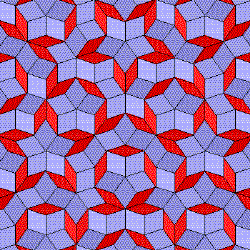
This is called a Penrose Tiling. This demonstrates the aperiodic layout of repeated tiling which gives an artistic visual of the quasicrystal.

I was first introduced to quasicrystals in physicist Lisa Randall's book, Warped Passages: Unraveling the Mysteries of the Universe's Hidden Dimensions. Randall was using them as an example of an every day item that may reflect "an ordered structure in a higher-dimensional world." She was talking about the Teflon on a pot or pan. Correction added 15OCT2011: Teflon is not what Ms Randall is describing... "non-stick" surface is more accurate...Teflon products have been around since long before the discovery of the non-stick effects of quasicrystal-reinforced surfaces. I apologize!


Dan Schechtman discovered the "impossible" crystalline structure over 20 years ago in a lab. In April of 1982, Schechtman had rapidly chilled a molten mix of aluminum and manganese expecting to observe complete disorder at the atomic level. Instead, he saw a crystal, except, it was one that did not make any sense.


It is important to note that the paradigm at the time was that crystals existed in limited numbers of rotation symmetry: 1, 2, 3, 4 & 6 fold. Not 5, and not greater then 6.

Quick vocabulary break down:
Crystals - usually, when atoms are arranged in a way which is periodic
Rotation Symmetry - When a shape or image can be rotated and it still looks the same. For 4-fold symmetry, for example, if you rotate the image four times, it looks the same each time (a square is of four fold symmetry).
Paradigm - a constant based not on theory but observation.

How the structure of an atom is observed: shine a monochromatic (or single wave-length of) xrays on a specimen. That beam is diffracted by the atoms and displays a pattern on the other side. This is where the symmetry number is revealed.


This is how an electron microscope works. What Schechtman saw was a diffraction pattern of electrons on a t.v. scanner...

What Schechtman did with his aluminum-manganese mix was observe the diffraction using an electron microscope and that diffraction pattern displayed a crystal with five-fold symmetry. It went against the paradigm which had existed since 1912! He quickly ruled out "twinned" atoms, or atoms which would have a mirror image in symmetry. What was significant about five-fold symmetry was that it produces a pattern that cannot be repeated; it takes the "periodic" out of the crystalline structure.


Schechtman was ridiculed by his peers for years, and he was even kicked out of his research group when he refused to back down on his findings.

Over the years, Schechtman's findings were slowly accepted into the scientific community and applied to modern technology, making stainless steel stronger (especially for small tools and instruments such as electric razors and surgical tools) and surfaces slicker. Quasicrystals have even been found to naturally occur in minerals found in a Russian river.


In her book, Lisa Randall explains the significance of quasicrystals to scientific theories that require extra spacial dimensions: "Quasicrystals are fascinating structures whose underlying order is revealed only with extra dimensions." As in, that periodical structure that can't be found in quasicrystals in three dimensions, may be, while not observable (by us), possible in extra dimensions of space. This would help to understand that non-stick pan coating: "The nonstick frying pans that are coated with quasicrystals exploit the structural differences between the projections of higher-dimensional crystals in the pan's coating and the more mundane structure of ordinary three-dimensional food."


Dan Schechtman's discovery resulted in some fantastic theory support as well as important applications. It is well deserving of a Nobel Prize. Congratulations, Prof. Schechtman!


References:

Randall, Lisa. Warped Passages Unraveling the Mysteries of the Universe's Hidden Dimensions. Harper Perennial. 2005.

"The Nobel Prize in Chemistry 2011 - Popular Information". Nobelprize.org. 10 Oct 2011 http://www.nobelprize.org/nobel_prizes/chemistry/laureates/2011/info.html

Technion Institue - Interview with Prof. Dan Shechtman.
http://www.youtube.com/watch?v=EZRTzOMHQ4s

Monday, August 22, 2011

Oil Spill Series: Tides

The physics of the ocean is essential to understanding the science of an oil spill. Besides the actual content of the oil and its effect on the environment, it is important to understand how the water behaves. This leads to processes which can determine the behavior or weathering of the oil. It plays a role in a responder’s ability to conduct clean-up.
When oil hits the water, earth’s forces immediately begin to go to work on it, both from above and below. For this segment, we look at how the tides work.


Tides
One of the cool things about the tides is that despite the constantly varying heights, they are completely predictable. We have predicted tides for a hundred years and more in the future (when I say “we” I don’t mean me…sounds like a completely tedious task, but I am glad someone out there enjoyed it enough to do it).

The tides are being influenced by three things: Gravity of the moon, the Earth’s rotation, and even a bit by the Sun’s gravitational pull. Each day, as the earth rotates, the gravitational pull of the moon creates a “bulge” on the earth and this causes a tidal change from low to high and high to low every 6 and a half hours.


Twice a month, the sun and moon are aligned (Full Moon and New Moon). When this occurs, the gravitational pull is even stronger and creates what are called Spring Tides. When the moon is at a right angle to the sun (half moon), the tidal change is less significant and is called a Neap Tide. The spring tide during the equinoxes have the highest tidal range (Owens, 1-17).

Equinox: the time when the sun crosses the plane of the earth's equator, making night and day of approximately equal length all over the earth and occurring about March 21 (vernal equinox or  spring equinox) and September 22 (autumnal equinox).


With these parameters laid out for us, the rule of thumb is that the tides at the equator (where the bulge is) are typically larger than those to the north or south. That is, until you take into account the geography.
Where your normal equatorial tide change is typically right around 2 meters, an example of a large tidal change due to tidal resonances is the Bay of Fundy (located between New Brunswick and Nova Scotia). The geography of this estuary supports a 15 meter tidal change (Bloomfield, 288)!

Resonance: is the tendency of a system to oscillate at a greater amplitude at some frequencies than at others

Resonance is a fascinating topic for another post, but note: due to the design of the landscape which the wave is traveling through, this tidal resonance occurs and causes phenomena such as the Bay of Fundy, the Cook Inlet in Alaska, and a handful of others.

Now, keeping in mind that this massive tidal change must still take place within the span of 6.5 hours, you can imagine the speed at which the ocean must move. Don’t get caught out there! This is a good concern to keep in mind when an oil spill response occurs in these areas…


The tank vessel EXXON VALDEZ struck Bligh Reef on March 24th, 1989. What is the significance of this date? Remember the effect that the equinox has on tides and when the equinox occurs? Also, what is the average tidal change for an area like Prince William Sound? These tidal effects all played a part in the behavior of the spill and the direction of the response to it.


Reference:
Bloomfield, Louis A. How Things Work. John Wiley & Sons, Inc. 2006.

Owens, Ed. Shoreline Operations and SCAT Surveys for Oil Spills on the West Coast. Polaris Applied Sciences, Inc. 2010

Saturday, August 6, 2011

Transfer of Heat: The Second Law of Thermodynamics

      Sometimes, it is counterintuitive to think that science does not allow “cold” to transfer. When you hold an ice-cube in your hand, it is most definitely, noticeably, making your hand cold! Yet, you have to wonder what is actually happening as the temperatures in both your hand and the ice-cube change.

      The second law of thermodynamics can be stated several ways and can even apply to more than just heat. We are going to stick with heat (thermal energy) because it makes me happy to stay consistent with “Thermo(heat) Dynamics(flow).”
      Before I jump into the definition of the second law, let me briefly explain the first law of thermodynamics: Energy can change form and travel but the quantity of energy is always the same. This is a brief explanation and is considered the happiest of the laws; should this be the only thermodynamic law, all the world’s energy problems would be solved! We would never have to re-fill our gas tanks, or pay for electricity...but this is for another post and I will bring you down a notch with the second law anyway.
      So, what is the Second Law of Thermodynamics already?! Well, simply put:
“A transformation whose only final result is to transfer heat from a body at a given termperature to a body at a higher temperature is impossible. (Postulate of Clausius)” (Fermi, 30)
      Ahem. Come again? Well, in the genius words of Flanders and Swann (musical duet from before my time):
Heat won't pass from a cooler to a hotter
You can try it if you like but you far better notter
'Cos the cold in the cooler will get hotter as a ruler
'Cos the hotter body's heat will pass to the cooler
Just Listen:

      
AHEM. Okay okay: Heat cannot spontaneously flow from a colder location to a hotter location.
      Thus, the ice-cube (you remember the ice-cube in the first paragraph?) is receiving the heat from your hand, not transferring “cold” to it... And your hand will continue to transfer this heat energy until it and the ice-cube are in “thermal equilibrium.” Which will either be when the ice has melted (in most cases) or when your hand has turned to ice.
      Hey, let’s talk about that second scenario real quick! Also known as frostbite, why on earth would the heat from your hand not melt the ice-cube before all of its thermal energy has been transferred? Well, in most cases, it is due to the speed of transfer. If the ice is so cold (due to size, or make-up, i.e., dry ice or liquid nitrogen) that there is a rush of transfer from your hand too fast to allow your body temperature to catch-up with the transfer, then you end up frostbitten. If that temperature is not raised in time to save the tissue, it causes permanent damage.

      Now, back on topic. There are three ways in which this transfer can take place: Conduction, Convection and Radiation.(Bloomfield, 211)
Conduction: Heat-flow through a stationary material. The atoms and molecules of the material are not “flowing” but the heat is... through vibrations of said atoms.
Convection: This is when heat is transferred through fluid. For instance, fluid air (moving air) can  carry heat from a hotter object to a cooler object.
Radiation: The transfer of heat through electro-magnetic waves (see previous blog post on microwave ovens).
      To imagine these transfers on a molecular and atomic level:
Conduction is a bucket-brigade where the atoms are the brigade and the material in the buckets is heat.

Convection occurs when this bucket brigade is riding on a “train” of fluid.
Radiation is the individuals of the brigade, and their buckets of heat, being carried in photons. J
I know, that last one was pretty much a cop-out analogy, but I might just have to do a completely separate post on radiation...Just know that the sun transfers heat through Radiation.

Now, this is a pretty simplified explanation of the second law. To go deeper, I would get into explanations of friction and other “work into heat” ideas and calories. I would particularly like to dedicate a separate post to calories...note to self...For now, I will leave the second law at this, and remember, “Heat won’t pass from a cooler to a hotter!”
Experiment to be done with adult supervision:
Take two bowls and put a scoop (or two) of ice-cream in each. Have a spoon ready to tasteJ. Pour milk (enough to coat, not so much that it is sopping) onto one of the servings, leave the other alone. Now taste. Pay attention to the temperature of each. What is the difference, if any? Why?

References:
http://en.wikipedia.org/wiki/Convection viewed on 08/6/2011. p. 5.

Bloomfield, Louis A. How Things Work. John Wiley & Sons, Inc. 2006.

Fermi, Enrico. Thermodynamics. Dover Publications, Inc. 1936.

Saturday, July 30, 2011

Microwave Ovens

Have you ever wondered how your microwave warms up your food, or worried that this mysterious process might be mutating what you ingest or even that those microwaves are escaping the box and penetrating your insides? Well, hopefully I can shed at least a little light on this magic hotbox and allay, well, some of your fears anyway.
Speaking of light, let me start with explaining what a microwave is. As in the actual, electromagnetic wave. You may have heard that light travels in waves, and that each color has a different wavelength. The rainbow shows the spectrum, and these colors are always in the same order...based on their wavelengths and frequencies. These visible waves are only a fraction of the spectrum. Other electromagnetic waves include radio waves, infra-red, x-rays, etc. (see spectrum below definitions).
Wavelength: Physics . the distance, measured in the direction of propagation of a wave, between two successive points in the wave that are characterized by the same phase of oscillation. Or:
Frequency: the number of cycles or completed alternations per unit time of a wave or oscillation. Symbol:  F; Abbreviation:  freq. Or:
1 Hz means that an event repeats once per second.
To demonstrate where your everyday waves fall on a spectrum, including the microwaves we are preparing to discuss, here is a helpful little picture:

Fantastic. Now we realize that the force we are working with in a Microwave Oven is electromagnetic, and have a basic understanding of the spectrum.
      The most important part of your microwave oven is the Magnetron. This nifty device is what is actually creating the microwaves and sending them into the box. When power is supplied electronically (i.e., plug it in and turn it on), the magnetron produces simultaneous electric and magnetic fields that oscillate at the right frequency to create microwaves. These microwaves emit from the magnetron, and are reflected off metal surfaces: A metal fan sends waves into the oven segment, the metal lined walls of the microwave oven reflect the waves throughout and back and forth.
      So now you have microwaves being reflected around the oven. What happens when you add food? First, let’s look at the make-up of the food you eat. Do you know what is common in almost everything you ingest? It’s water molecules. It is these molecules of H2O that are the key to microwaves increasing the temperature of the object inside the oven. This is due to the fact that these molecules are polarized.
      When the Oxygen (O) atom combines with the two Hydrogen (H2) atoms, it pulls the electrons partly from the Hydrogen…creating a negative charge on the Oxygen end of the molecule. This in turn creates a positive charge on the H2 end of the molecule, and there you have your polarization.
      As the fluctuating electric field of a microwave passes by these water molecules, it causes the polarized water to in turn fluctuate…and at the speeds that they begin to fluctuate, heat is in turn created! The excited water is turning the work energy into heat and that is a thermodynamics lesson for another post.
This leaves us with a couple of questions still from the introduction.
Are these microwaves escaping and cooking your insides? The answer is no. Take a look at your microwave oven. All the walls, save the door, are all-metal surfaces. The door is a mesh design of metal and amazingly, those holes in the mesh are TOO SMALL to allow the escape of the microwaves. Fabulous, right?
Are these microwaves mutating your food? Pure water molecules are not going to be changed by the effects of microwaves. That being said, the complex carbon chains that make up the rest of most foods may be affected by the microwaves, but to what extent, I don’t know. If you know, please feel free to post a response, I would love to hear what others have to say!
Experiment:
Try (with adult supervision, if you are a minor) microwaving an ice-cube or ice-cubes. What happens? Can you explain why?
Formula (for the math-happy science geeks):
C = λ(ν) or speed of light = wavelength times frequency
Electromagnetic waves always travel at the speed of light, and therefore, the higher the frequency, the shorter the wavelength.


References:

Bloomfield, Louis A. How Things Work. John Wiley & Sons, Inc. 2006. p 432.

 Fischetti, Mark. How the Microwave Works. Scientific American. Oct 30, 2008.
http://www.scientificamerican.com/article.cfm?id=how-the-microwave-works
viewed at link on Jul 30 2011.

Definitions from: http://www.dictionary.com/